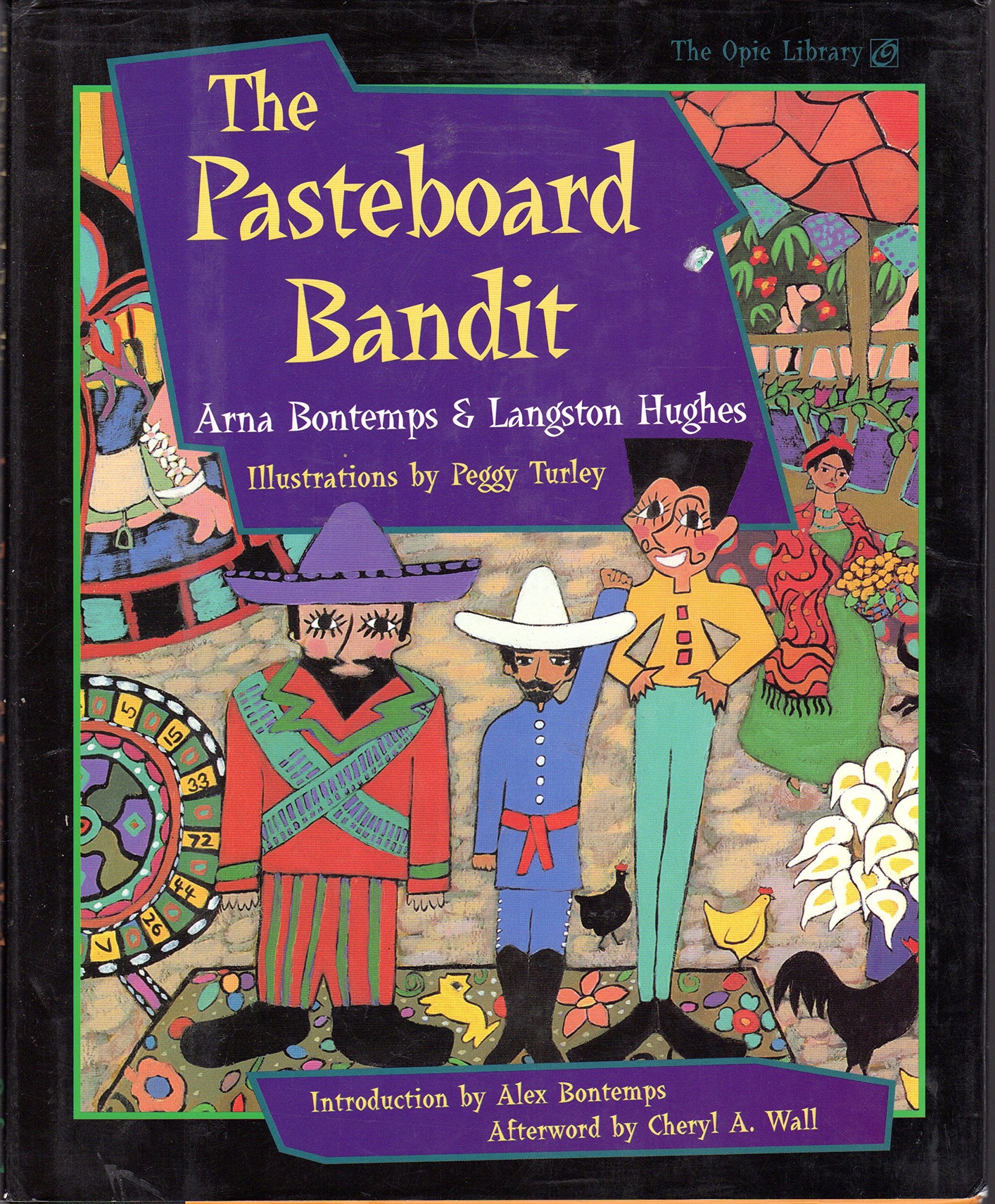
The Pasteboard Bandit (The ^AIona and Peter Opie Library of Children's Literature)
$38.00
by Arna Bontemps



In this delightful children's tale, an American boy, Kenny Strange, moves to the quiet Mexican town of Taxco with his parents and strikes up a friendship with young Juanito Pérez, a Taxco native. The two boys are brought together by an enchanting toy, the pasteboard bandit Tito. Chosen by Juanito at a town fair from among the other pasteboard toys, Tito, with his colorful clothes and bright eyes, becomes Juanito's and Kenny's constant companion, and the threesome share many adventures in and around the town's rolling green hills. The boys' growing friendship, Kenny's introduction to a culture unlike his own, and Tito's witty reflections on being a toy will be recognized instantly by anyone young or old who has ever made a friend or imagined that a toy might be real. Originally written in 1935, but never before published, The Pasteboard Bandit grew out of several trips Langston Hughes made to Mexico during his lifetime. Hughes first went to the town of Toluca at age 5 to visit his father, and again when he was older. During these visits, Hughes met many writers and artists, and it is their influence that informs the story of The Pasteboard Bandit --a story of two cultures meeting. When Hughes left Mexico for the last time, at age 32, he was carrying the first draft for The Pasteboard Bandit . Grade 3-6?Tito, a papier-mache doll, stars in this rather dull tale set in Mexico. With Tito always at their sides, young Juanito and his American friend Kenny engage in a series of minor adventures, including being locked in an abandoned mine, mistaking holiday fire crackers for gun shots, and listening to serenaders. Written in 1935 and unpublished until now, the book has dated and mechanical dialogue. On the whole, the writing has not aged well, and an occasional switch from third person is jarring. The narrative does depict rural Mexican life and holiday celebrations adequately, but there's nothing here that can't be found in many higher-quality titles.?Denise E. Agosto, formerly at Midland County Public Library, TX Copyright 1998 Reed Business Information, Inc. Ages 5^-8. Like Hughes' The Sweet and Sour Animal Book (1994), this gentle fantasy was first written in the mid-1930s, never found a publisher, was recently "uncovered" among Hughes' papers, and is published now for the first time (as part of the Opie Library). And like the Animal book, this will appeal more to adult collectors than to children. The story is set in a small town in Mexico and tells of the friendship between two boys, a Mexican and an American, and their little pasteboard carnival toy. The style is saccharine and cute (the word little appears several times on nearly every page), and the fantasy framework is contrived. However, the friendship across cultures is drawn without condescension; the Mexican setting is authentic and joyful, from food and scenery to language and pinatas; and Turley's gorgeously colored acrylic illustrations evoke Mexican folk art and murals. Older readers will be fascinated by the biographical and historical notes about Hughes and Bontemps and their friendship. An exhibit with the paintings and the story of the book is touring the country. Hazel Rochman Sandwiched between an introduction by Bontemps's son and a biographical and analytical afterword is a never-before-published story, innovative for its time, written in 1935 by two icons in the history of African-American literature. The story, which has not aged well, will find its most appreciative audience in readers familiar with the authors' other works. As Hughes's hand-painted pasteboard bandit, Tito (six inches high, with a ``furious little rabbit beard'' and raised fist), looks on with interest, Juanito introduces Kenny, the son of vacationing New York artists, to his small Mexican town, the surrounding hills, and Christmas and Easter festivities. The plot is loosely constructed--Juanito takes an entire chapter to nod off after a Christmas Eve posada--and, despite the authors' efforts to depict an international friendship among equals there is still some overt cultural relativism: After several local children fail to break the pi¤ata, Kenny succeeds, then drowsily remarks on the way home, ``A pi¤ata's almost as good as a Christmas tree.'' In a dozen full-color, full-page paintings, Turley uses a vibrant palette and stylized figures reminiscent of some Mexican folk art, creating lush scenes of flowers and toys. Consider this a long-lost literary relic, available at last, more for study than pleasure. (Fiction. 12+) -- Copyright ©1997, Kirkus Associates, LP. All rights reserved. "Hughes and Bontemps successfully capture the lush Mexican culture with all its sights and sounds. Turley's vivid, Mexican-inspired illustrations pair nicely with this warmhearted story.... Sure to charm children and adults."-- MultiCultural Review "Makes a sincere and convincing appeal for racial tolerance, presented to readers within a parable of family love and childhood